
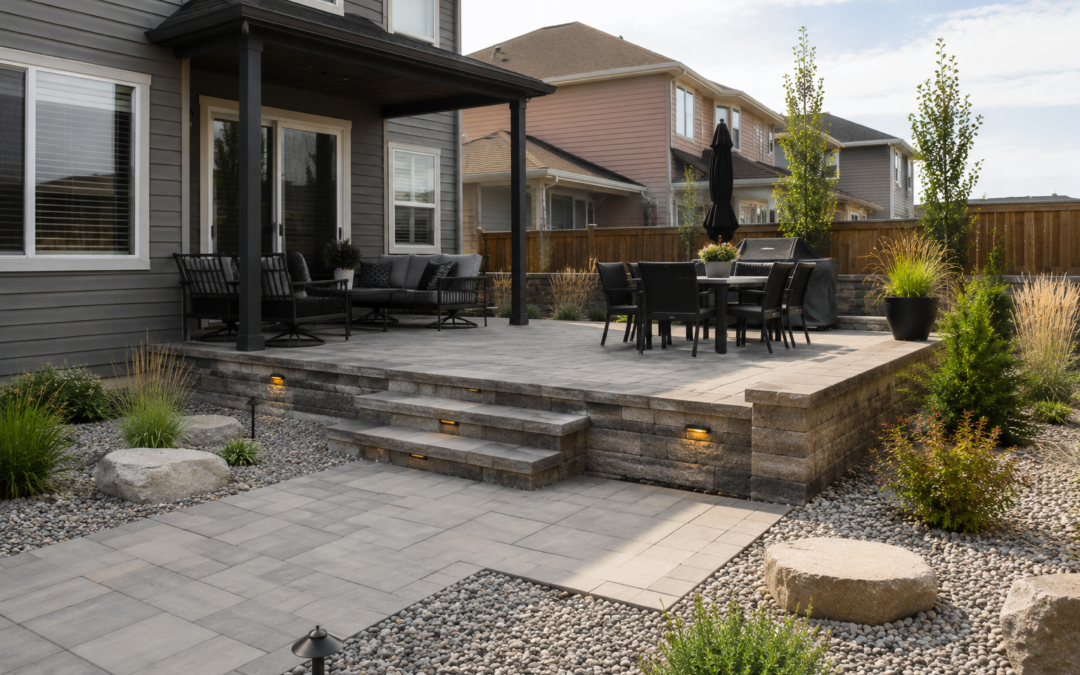
Paving stone patios are often the better fit for Okotoks yards when you want design flexibility, easier spot repairs, drainage options, and strong performance through Alberta freeze-thaw cycles. Concrete can still be a practical choice when you want a simple, clean slab and fewer material joints. The right answer depends on your budget, site access, drainage, style, and how you plan to use the patio.
A patio is not just a surface. It is the foundation for how you cook, sit, entertain, supervise kids, move between doors, and enjoy the yard. In Southern Alberta, it also has to deal with snow, chinooks, spring melt, summer storms, shifting temperatures, and the occasional heavy load from furniture, planters, fire tables, or outdoor kitchens.
The Short Version
Choose paving stones if you want a more custom look, modular repairs, curves, borders, permeable options, and easier changes later. Choose concrete if you want a straightforward slab, a modern minimal look, and fewer joints under furniture. Both materials can fail if the base, grade, drainage, and edge restraint are wrong. For high-intent patio searches in Okotoks, the useful question is not just which surface is cheaper; it is which system fits the slope, access, drainage, steps, retaining walls, and winter maintenance of your specific yard.
That last part matters most. In Okotoks and Calgary, patio durability comes from what you do below the surface. Excavation depth, compacted base, slope away from structures, drainage, bedding, control of edges, and winter movement all influence how the patio performs.
How Paving Stone Patios Work
A paving stone patio is built from individual units installed over a prepared base. The base is compacted, bedding material is placed, pavers are laid in the selected pattern, edges are restrained, and joints are filled. The finished surface can be simple and neutral or detailed with borders, inlays, curves, contrasting colours, and transitions to walkways or steps.
The Concrete Masonry and Hardscapes Association describes interlocking concrete pavements as a durable pavement solution and also notes that permeable interlocking concrete pavement can help reduce runoff by storing water in aggregate spaces and allowing infiltration into the subgrade. For a homeowner, that means pavers can be part of both the design and water-management conversation.
Kayben’s patio and hardscape project gallery is a useful place to look for examples of patios, seating areas, walkways, and hardscape details before choosing a direction.
How Concrete Patios Work
A concrete patio is poured as a slab over a prepared base, then finished with the chosen texture, broom finish, or decorative treatment. Concrete can look crisp, modern, and clean. It can work well for rectangular patios, side-yard pads, hot tub pads, and simple outdoor dining areas.
Concrete is not maintenance-free, though. It can crack, spall, settle, stain, or heave if base preparation, drainage, control joints, or finishing conditions are not handled properly. Cracks do not always mean the patio was poorly built, because concrete naturally shrinks and moves, but visible cracking can be frustrating on a finished outdoor living space.
Freeze-Thaw Performance in Alberta
Freeze-thaw is a central issue for Okotoks patios. Water enters small gaps, pores, joints, or poorly drained base material. When temperatures drop, that water freezes and expands. When a chinook or warm spell arrives, it thaws again. Repeated cycles can stress slabs, joints, edges, and low spots.
Paving stones handle movement differently than one continuous slab. If a small area settles, a contractor can often lift and reset that section rather than remove the whole patio. Damaged individual pavers can usually be replaced. Concrete repairs are possible too, but patches, crack repairs, and slab replacement are often more visible.
This does not mean pavers are automatically better on every site. A poorly built paver patio can still settle, spread, or become uneven. A well-built concrete patio can perform for many years. The installation quality matters more than the sales pitch.
Drainage and Grading
Every patio should move water away from the house and away from places where ice can form. That is true for both pavers and concrete. If your yard already has low areas, negative slope, compacted clay, or downspouts discharging near the future patio, solve those issues before choosing the surface.
Pavers can offer more drainage flexibility, especially when designed with permeable systems or integrated with landscape beds. Concrete sheds water as a surface, so slope and edges need to be planned carefully. In a tight side yard or small backyard, even a slight grading mistake can send runoff toward the foundation, fence, neighbour, or walkway.
This is why patio planning belongs inside a full professional landscape design conversation, not just a material quote. Competitors with narrow retaining wall or paver pages can win one service query; a stronger patio plan should show how the patio connects to walls, steps, walkways, sod, planting, lighting, and future outdoor living features.
Appearance and Design Flexibility
Pavers offer more design variety. You can choose colours, sizes, laying patterns, borders, curves, steps, and transitions. They work well when a patio needs to connect to a fire pit area, garden path, retaining wall, deck stairs, or outdoor kitchen zone. Pavers can make a small yard feel custom because the pattern can respond to the exact space.
Concrete is cleaner and quieter visually. For modern homes, large windows, simple lines, or minimalist yards, that can be the right look. Decorative concrete can add texture or colour, but it is still usually less modular than pavers.
The best choice is the one that fits the house. A ranch-style acreage, a new-build home in a compact Okotoks lot, and a south Calgary backyard with mature trees may all call for different patio styles.
Maintenance and Repairs
Paver patios need joint maintenance over time. Depending on the product and exposure, joints may need topping up or refreshing. Weeds can appear in neglected joints or along edges. Snow clearing should be done carefully so edges are not damaged. The tradeoff is that pavers are easier to adjust in sections.
Concrete patios need cleaning and may need sealing depending on the finish. Cracks should be monitored and addressed before water intrusion makes them worse. De-icing products should be used carefully because harsh products can damage surfaces and nearby planting beds.
Both materials benefit from good winter habits: manage drainage, avoid piling heavy contaminated snow on delicate edges, and address trip hazards early.
Budget and Long-Term Value
Concrete is often chosen when homeowners want a simpler slab and lower complexity. Pavers often cost more because of the base, labour, pattern work, edge restraints, cutting, and detail involved. That said, the cheapest patio is not always the best value if it cracks, drains poorly, or does not fit how the yard is used.
If budget is the sticking point, consider phasing. Build the right-sized patio now, then add a seating wall, pergola, planting, lighting, or outdoor kitchen later. Kayben’s landscaping financing options may also help homeowners plan a larger landscape project without cutting important construction details.
Frequently Asked Questions:
Are paving stones better than concrete in Okotoks?
Paving stones are often a strong choice because individual units can move slightly and be repaired in sections. They also offer more design flexibility. Concrete can still be a good option for simple, clean slabs when the base, slope, and joints are built correctly.
Do paver patios need maintenance?
Yes. Paver patios may need joint maintenance, edge checks, cleaning, and occasional resetting if settlement occurs. The advantage is that repairs are often localized instead of requiring replacement of a large slab.
Can I add a patio as part of a larger yard renovation?
Yes, and that is usually the best approach. Patio placement should connect to doors, drainage, grading, walkways, planting, irrigation, and future features. Planning the whole yard helps the patio feel intentional.
Choose the Surface That Fits the Yard
The right patio is not decided by material alone. It is decided by how your yard drains, how your family uses the space, what look suits the home, and how much flexibility you want in the future. If you are comparing paving stones and concrete for an Okotoks or Calgary-area yard, Kayben can help you weigh the options through design and construction planning.