
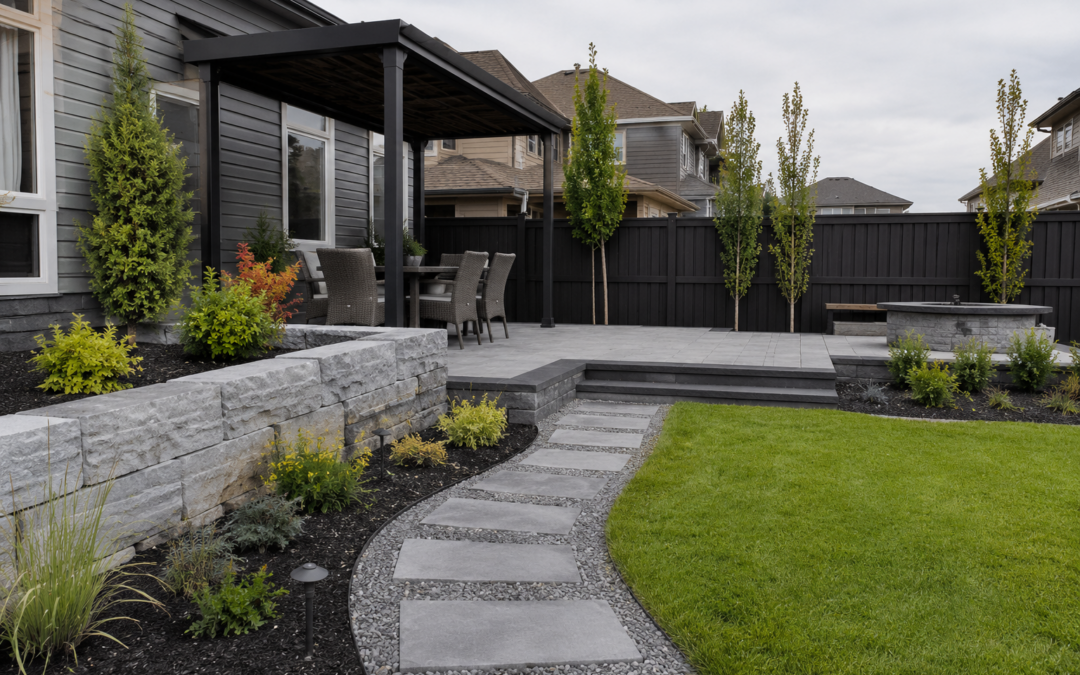
Residential landscape construction in Okotoks usually moves through consultation, site review, design, budgeting, proposal review, scheduling, construction, change order management, walkthrough, and aftercare. The best projects start with clear expectations because Alberta yards are not just decorative spaces. They need grading, drainage, hardscape, planting, irrigation, and materials that can handle local wind, winter, sun, and freeze-thaw conditions.
If you are building a new home landscape in D’Arcy, Wedderburn, Greenhaven, an acreage near the Foothills, or an older Okotoks yard that needs a full reset, the process matters as much as the finished look. A strong landscape plan helps you avoid rushed choices, prevent drainage issues, and invest in features you will actually use.
Step 1: Decide What Problem the Yard Needs to Solve
Before talking about pavers, trees, turf, or fire features, define what is not working. Is the yard unfinished after a new build? Is the lawn hard to water? Do you need privacy from neighbours? Is there a slope that limits use? Are you trying to create a patio, a low-maintenance front yard, a play space, or a more polished entry?
This step keeps the project practical. Okotoks homeowners often deal with exposed lots, clay-heavy or compacted soils, drainage swales, HOA or architectural controls in newer communities, and winter snow storage. A good landscape should work with those conditions instead of pretending they do not exist.
Step 2: Consultation and Site Review
A professional consultation looks at how the yard is used, where water moves, what access is available for crews and equipment, and how the finished landscape should connect to the house. Kayben’s landscape construction process begins with an inquiry and consultation so the team can understand your vision, scope, budget, and property constraints before a proposal is built.
For homeowners, this is the time to gather useful information. Your Real Property Report can help identify property lines, rights-of-way, structures, and utility considerations. Photos of inspiration yards are helpful, but so are photos of puddling, erosion, dead turf, or awkward traffic paths. The more real information the designer sees, the better the plan can respond.
Step 3: Design That Fits the Site
A finished landscape is much easier to build when the design is more than a pretty sketch. Kayben’s professional landscape design services can include an in-yard consultation, landscape plan, construction detail, planting plan, material selection, grading, and elevation considerations.
That matters in Alberta because the design has to survive more than one photo day. Plants need to suit local hardiness and exposure. Patios and walkways need a proper base. Retaining walls need to respect grade and drainage. Irrigation needs to match zones and sun exposure. A front yard xeriscape, a backyard patio, and a family lawn all have different construction requirements.
What Your Design Should Clarify
A practical residential landscape design should answer where people will walk, sit, gather, and store things. It should show how water will move away from the house and hardscape, which areas need irrigation or drought-tolerant planting, what materials will be used, where snow will be piled in winter, and what can be built now versus later. This is the detail many thin Okotoks service-area pages miss: material choices, permit questions, construction access, plant hardiness, and proof that the contractor understands newer communities as well as established yards.
Step 4: Budgeting and Proposal Review
A good proposal should make it clear what is included, what is optional, and what could change if site conditions are different than expected. Residential landscaping often includes a mix of excavation, base preparation, grading, topsoil, sod or seed, planting, mulch, irrigation, patios, pathways, fences, walls, lighting, or water features. A small front yard refresh and a full backyard build are very different projects.
This is also where phasing can help. If your dream yard includes a patio, pergola, outdoor kitchen, water feature, and full planting plan, you may choose to build the foundation first and add premium features later. Kayben’s quote process gives homeowners a way to start the budget conversation before the project becomes overwhelming.
Step 5: Permits, Rules, and Property Constraints
Not every landscape feature needs a permit, but some work does require review. The Town of Okotoks provides permit guidance for residential construction, and deck rules are a good example: height, setbacks, land use standards, and rights-of-way can affect what is allowed. Even when your project is mostly landscaping, it is smart to check before building structures, decks, major retaining walls, or work near utility rights-of-way.
Newer communities may also have architectural guidelines. Condo-style or HOA-governed properties may need approval for fences, front yards, or visible features. Your contractor can help identify the questions to ask, but the property owner is still the one who should understand the rules attached to the lot. If you are comparing Okotoks contractors, ask how they handle Real Property Reports, drainage swales, access limits, and phased budgets before you ask for a final number.
Step 6: Pre-Construction Planning
Before crews arrive, confirm access, material staging, parking, irrigation shutoffs, pet arrangements, neighbour considerations, and areas that need protection. Alberta landscape construction can be dusty, muddy, noisy, and temporarily disruptive. That does not mean something is wrong. It means your yard is a construction site for a short period before it becomes a finished outdoor space.
A pre-construction meeting should clarify the schedule, scope, materials, site access, and who to contact with questions. If changes come up, they should be documented before the work proceeds. Change orders protect both the homeowner and the contractor because they keep cost, timing, and expectations visible.
Step 7: Construction and Quality Checks
The build phase may include demolition, excavation, grading, drainage adjustments, base preparation, hardscape installation, wall construction, irrigation, soil preparation, planting, sod, mulch, and cleanup. The order depends on the project. Heavy work usually comes before delicate finishes. Irrigation often needs to be coordinated before final sod or planting. Hardscape base preparation is critical because patios and walkways have to handle freeze-thaw movement.
Do not judge the project halfway through. A yard can look worse before it looks better. The right thing to watch is communication. Are questions being answered? Are changes documented? Is the site being kept as safe and tidy as practical? Are materials matching the approved plan?
Step 8: Walkthrough and Aftercare
At completion, walk the yard with your contractor. Confirm the scope is complete, understand how to care for new plants and sod, ask how to run irrigation, and get warranty or maintenance information in writing. New landscapes need attention. Fresh sod needs watering. New trees and shrubs need establishment care. Gravel, mulch, and paver joints may settle slightly and need monitoring.
The best landscapes are not just installed. They are handed over clearly so the homeowner knows how to protect the investment.
Frequently Asked Questions:
How long does residential landscape construction take in Okotoks?
Timing depends on project size, design complexity, material availability, weather, and schedule. A simple front yard refresh may move quickly, while a full yard with grading, walls, patio, irrigation, planting, and structures takes longer and may require phasing.
Do I need a design before getting a landscaping quote?
For small updates, a basic scope may be enough. For full yard construction, patios, walls, grading, irrigation, or complex planting, a professional design makes the quote more accurate and reduces surprises during construction.
What should I prepare before my consultation?
Bring your goals, budget range, Real Property Report if available, inspiration photos, problem photos, community guidelines, and a list of must-haves. Be honest about how you use the yard, how much maintenance you want, and what matters most.
Build the Yard Around Real Life
A good Okotoks landscape should look beautiful, handle the climate, respect the site, and fit the way your family lives outside. If you are planning a new yard or renovation, start with a conversation, a clear scope, and a design that can be built properly. Kayben can help you move from idea to finished space through design, construction, and quote planning.